ARAZZO
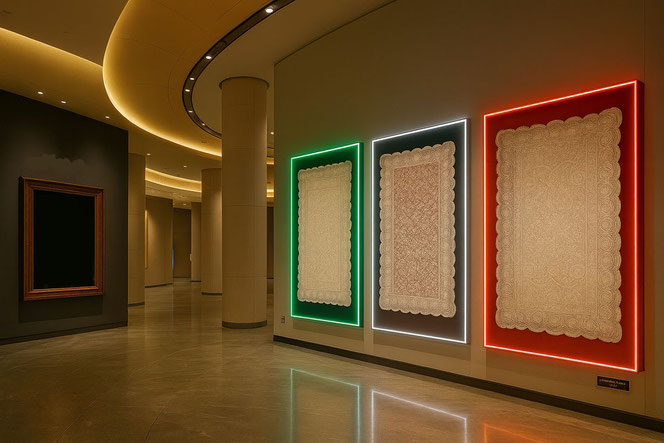
A New Investment Thread in the Art Market
Cantù lace tapestries as unique, long-term art investments.
🏛️ MUSEUM artifacts
Cantù Bobbin-Lace Tapestries
Private Collection — Cantù, Italy
Cantù bobbin-lace tapestries represent one of the most refined expressions of European textile heritage.
Rooted in a centuries-old Lombard tradition, these monumental works reinterpret an artisanal language that blends structure, time, and precision into a single, unified artistic gesture.
Entirely handmade according to the historic Cantù technique, each tapestry requires 25,000–30,000 hours of uninterrupted manual
work.
The original drawing is destroyed at the end of the process, ensuring that every work remains a unique, unrepeatable creation, inseparable from
the hands that shaped it.
With dimensions approaching 300 × 200 cm, these tapestries embody an extraordinary mastery of thread manipulation, where pattern, texture and
light interact to form a delicate yet powerful visual architecture.
They carry a cultural legacy rooted in Brianza at the end of the nineteenth century and continue to evolve through contemporary craftsmanship.
Beyond their aesthetic significance, these works testify to a broader social history.
Bobbin lace supported the emancipation of generations of women, becoming a vehicle of economic independence and artistic
recognition.
It also elevated the role of master designers and artisans, helping define Cantù as one of Italy’s foremost centers of textile arts.
🏛️ A Note on Textile Art Today
In recent years, textile arts have gained renewed international attention, with museums and biennials exploring the narrative potential of weaving, knotting, embroidery, and
lace-making.
Tapestries and fiber-based works are increasingly positioned at the intersection of craft, design, and contemporary art, challenging traditional
boundaries between decorative and fine arts.
Within this broader panorama, Cantù bobbin-lace tapestries occupy a distinct and distinguished space:
they are architectures of time, constructed from thousands of precise gestures, and embody a rare continuity between historical tradition and
contemporary artistic sensibility.
#meraviglieditalia
🏛️ In conclusion, these are first-rate works: large-scale carpets that must be regarded as true works of art, comparable to some of the highest expressions and valuations in the international art scene. Made in Italy.


Tapestry I — Unique Piece (Cantù)
Technique: bobbin lace (not embroidery)
Name: “Festa delle cornucopie”
Dimensions: approx. 300 × 200 cm
Working hours: ~30,000
Uniqueness: original pattern destroyed
Provenance: Private Collection
17th International Cantù Bobbin Lace Biennial, Como, Italy, 2025
Based on family archives and internal documentation.
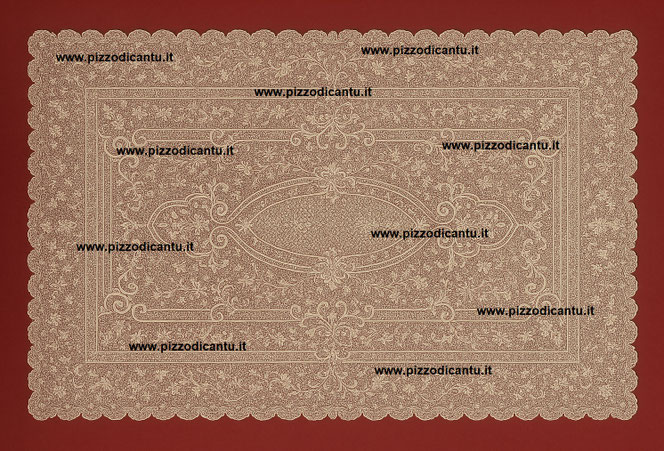
Tapestry II — Unique Piece (Cantù)
Technique: bobbin lace (not embroidery)
Name: "Sinfonia Rinascimentale - Mimosa"
Dimensions: approx. 300 × 200 cm
Working hours: ~25,500
Uniqueness: original pattern destroyed
Provenance: Private Collection
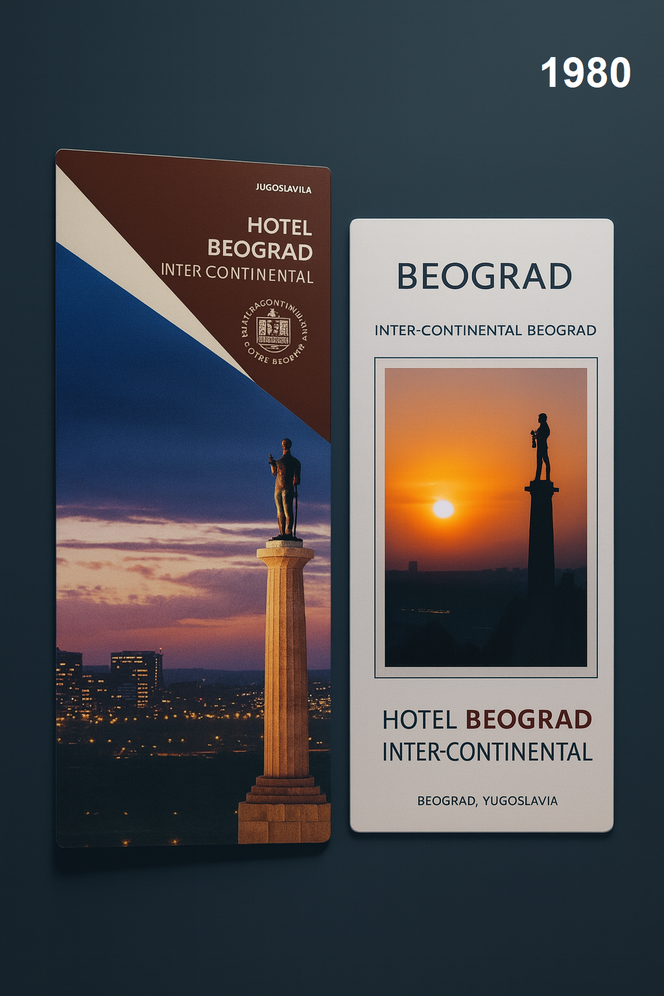
Hotel Beograde InterContinental – Belgrade, Yugoslavia (today Serbia),
1980
Hotel InterContinental Zagreb – Zagreb, Yugoslavia (today Croatia),
1980
Based on family archives and internal documentation.
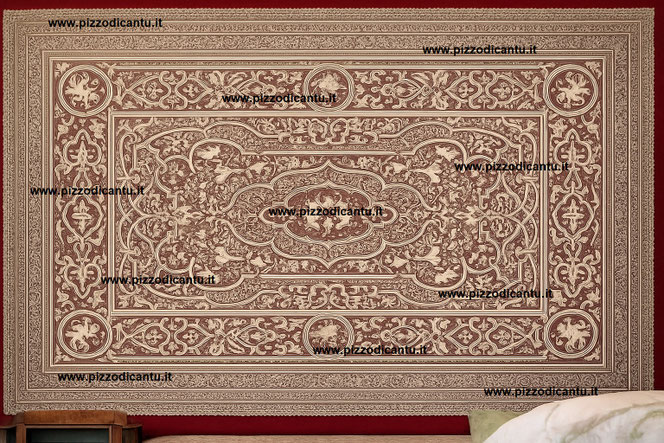
Tapestry III — Unique Piece (Cantù)
Technique: bobbin lace (not embroidery)
Name: “Armonia Barocca”
Dimensions: approx. 300 × 200 cm
Working hours: ~28,300
Uniqueness: original pattern destroyed
Provenance: Private Collection
Cairo Capital Club – Cairo, Egypt, 1995
Based on family archives and internal documentation.
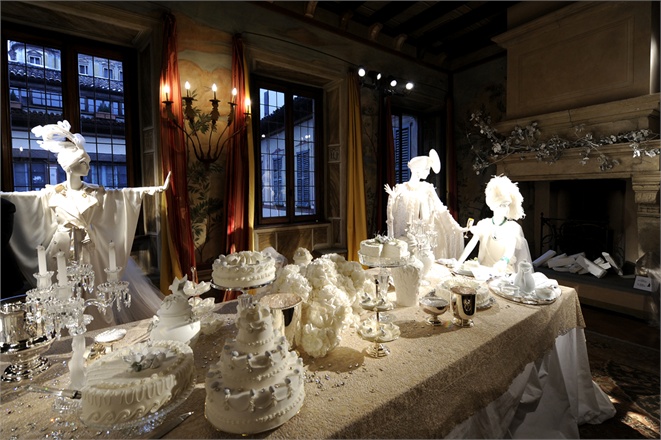
#meraviglieditalia at: Vogue Gioielli, Milan, Italy
Based on family archives and internal documentation.
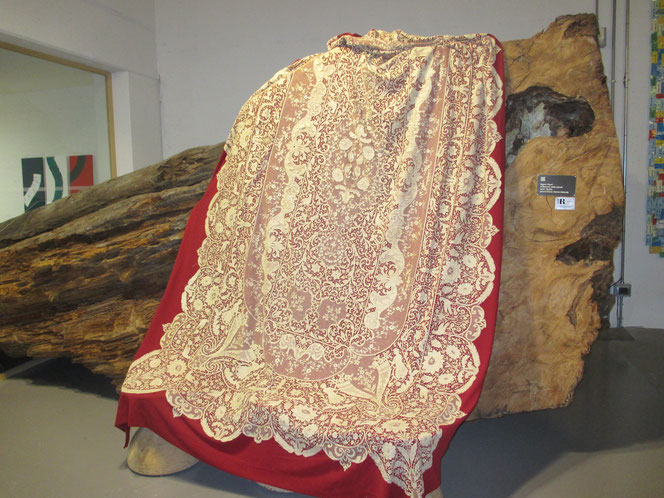
#meraviglieditalia at : Riva 1920, Cantù, Italy
Based on family archives and internal documentation.
Be humble, be slow.
In an age defined by speed and constant change, Marelli Pizzi di Cantù (Italy) remains faithful to the value of time. With deep respect for nature and for those who came before us, we carry forward the art of bobbin lace, inherited from past generations; our carpets and tapestries are its most tangible expression.
Inspired by a centuries-old tradition and by the cultural heritage of our hometown, we present these works in settings that combine classical elegance and timelessness, originality and sustainability. They are works woven slowly, conceived to endure—objects that embody time rather than simply occupy it.
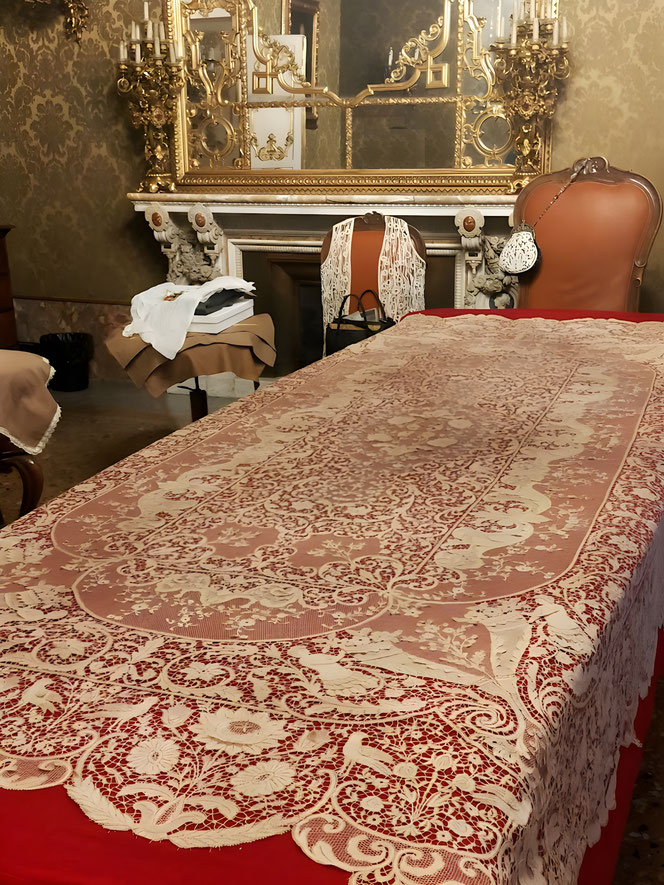
#meraviglieditalia at : Palazzo Malvezzi, Bologna, Italy
Based on family archives and internal documentation.

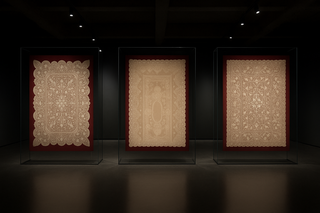
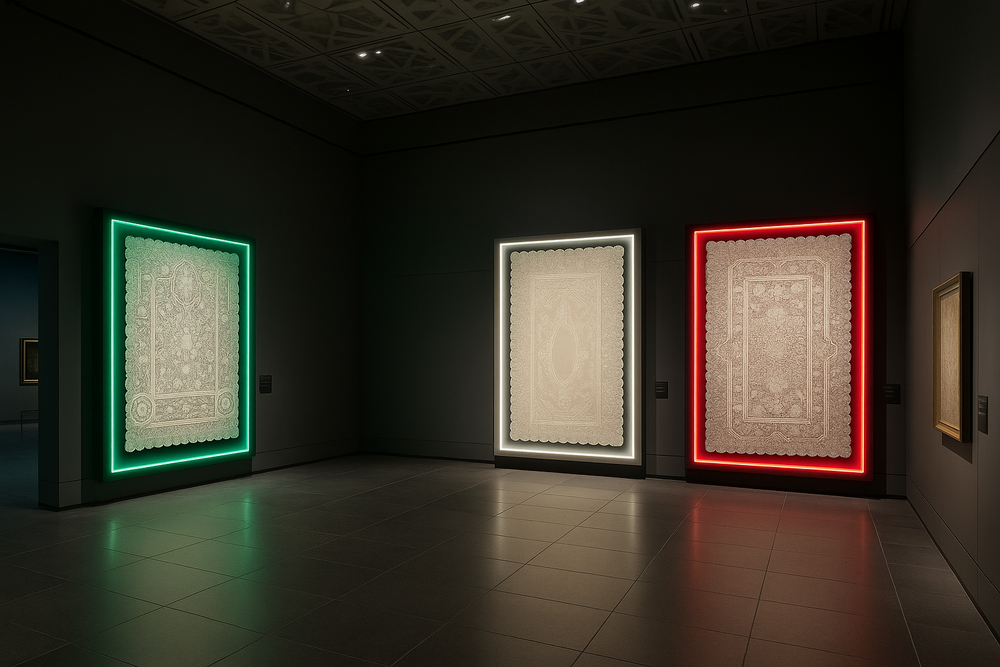
🏛️ Over the years, the Marelli family has had the privilege—by special invitation—to present selected tapestries and lace artworks in distinguished and iconic venues.
Below is a curated overview of the most significant exhibitions.
Exhibition History :
1971-2 – Sicily and Calabria
In 1970, a series of exhibitions and presentations devoted to bobbin lace (Pizzo di Cantù) were held in prominent venues in Southern Italy, including:
– Barcellona Pozzo di Gotto, Messina
– Taormina, Messina
– Roof Garden Hotel, Reggio Calabria
The initiatives were promoted by distinguished local figures, among them Dr Ziino, Dr Cuzzocrea and Mr. Serafino bearing witness to the growing cultural and collecting interest in this unique textile art.
1978 – Riyadh -Saudi Arabia
Paolo Marelli & Mazza travelled to Riyadh at the invitation of a consulate to present and illustrate the Cantù bobbin-lace tapestries during a private exhibition.
Based on family archives and internal documentation (Al-Otaibi & Habib).
1980 - Hotel Beograd InterContinental – Belgrade, Jugoslavia (today Serbia)
Exhibition dedicated to European applied arts.
The tapestries were displayed in one of the hotel's historic halls, renowned for its architectural and cultural heritage. Today is Crowne Plaza Belgrade.
Based on family archives and internal documentation (Maric).
1980 — Hotel InterContinental Zagreb - Zagreb, Jugoslavia (today Croatia)
Official exhibition dedicated to Italian textile craftsmanship.
The tapestries were showcased in the main hall during cultural and diplomatic events. Today is The Westin Zagreb.
Based on family archives and internal documentation (Pikovic).
1983 — Moscow, near Red Square - Moscow, USSR (today Russia)
Private presentation inside a historic hotel complex adjacent to the former Hotel Rossiya (later demolished during the Zaryadye redevelopment).
A reserved event attended by international collectors and cultural delegates.
Based on family archives and internal documentation (Dobrokic).
1984-92 Monte Carlo - Principality of Monaco
Between the 1980s and 1990s, in Monte Carlo, through the intercession of Monsignor E. S., several private exhibitions were organized for selected local entrepreneurs.
Based on family archives and internal documentation.
1998 – Cairo Capital Club - Cairo, (Egypt)
Located in the vibrant heart of the Egyptian capital, the Cairo Capital Club is one of the city’s most exclusive circles—frequented by diplomacy, business, and culture.
The exhibition engaged seamlessly with this high-profile international setting, where tradition and prestige naturally intertwine.
Based on family archives and internal documentation (Nourr & Amir).
2000 - Grand Hotel et de Milan – Milan, (Italy)
Special exhibition held for the Centenary of Giuseppe Verdi’s death.
The works were displayed in one of the hotel’s historic cultural rooms, highlighting the dialogue between Italian literary heritage and fine art craftsmanship.
2001 – 5th International Cantù Bobbin Lace Biennial – Cantù, Como, (Italy)
Based on family archives and internal documentation.
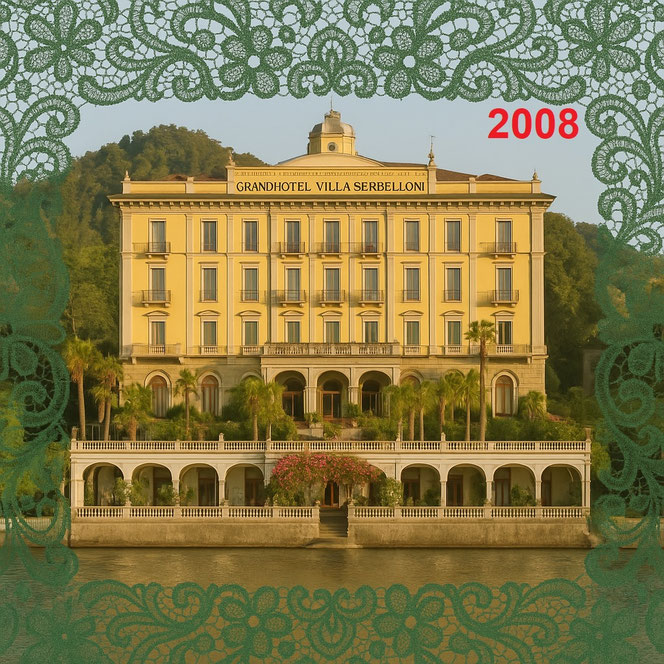
2009 – Grand Hotel Villa Serbelloni - Bellagio, (Italy)
In this prestigious setting, the artworks integrated naturally into the environment—not as mere decoration, but as a continuation of Lombard cultural tradition, harmoniously expressed in the grand residences overlooking Lake Como.
2009 — Cantù - Italy (Italy)
Mediaset Canale 5, TV show Striscia la Notizia, “Antitarocco – Mago di Az e Luca Galtieri”: one of
the Marelli tapestries was featured on air as an example of authentic Italian high craftsmanship (link page) .
Based on family archives and internal documentation.
2010 – Vogue Gioiello - Milan, (Italy)
From Lake Como to the capital of fashion and design.
Being featured in Vogue Gioiello confirmed that Cantù lace is not only tradition but a true language of style—recognized on the same level as a jewel, a couture garment, or a design object.
Based on family archives and internal documentation.
2014 – Riva 1920 - Cantù, Como, (Italy)
Riva 1920 works with certified Kauri woods, dated to over 40,000 years of age.
The tapestry was deliberately placed in relation to these exceptional ancient timbers, as its creation also required more than 25,000–30,000 hours of work: two different materials, both shaped by time, brought into dialogue between geological depth and artisanal patience.
Based on family archives and internal documentation (Riva)
2015 — Saint-Vincent - Aosta (Italy)
During the event “Il più bello d’Italia”, a Marelli tapestry was exhibited as a testament to the quality of Cantù bobbin-lace craftsmanship.
Based on family archives and internal documentation (V. Carfagna).
2021 — Isernia (Italy)
At the Petrecca Art Gallery, a Marelli tapestry was displayed on the occasion of the inauguration of the First “Albero della Felicità”, a collective bobbin-lace artwork created by the local community of Isernia.
Based on family archives and internal documentation (Carmela I.)
2022–23 — MCC - Como, (Italy)
The Power of Threads, a project dedicated to Prof. Marco Camisani Calzolari, one of Europe’s foremost experts in digital communication. He attended the inauguration of the 16th Biennale of Cantù and the opening of a solo exhibition of the Tapestries (MCC).
Based on family archives and internal documentation.
2023 – Palazzo Malvezzi - Bologna, (Italy)
The tapestry was presented as part of a photographic exhibition linked to a UNESCO-related project, helping to highlight Cantù bobbin lace as an expression of intangible cultural heritage.
Based on family archives and internal documentation (Renata).
2025 – 17th International Cantù Bobbin Lace Biennial – Cantù, Como, (Italy)
During the 17th edition of this international biennial, the tapestry was presented alongside bobbin-lace masterworks created by designers including Marcello Morandini, Marco Camisani Calzolari, Serena Confalonieri, Paolo Ulian, Andrea Branzi, Michele De Lucchi, Terry Dwan, Martino Gamper, Anna Gili, Ugo La Pietra, Lombardini22, Alessandro Mendini, Angela Missoni, Elena Salmistraro, Luca Scacchetti, Thessy Schoenholzer Nichols, Nanni Strada, Patricia Urquiola and Nanda Vigo, placing the work in dialogue with some of the leading voices in contemporary Italian design.
Based on family archives and internal documentation (Renata).
⭐ PRIVATE COLLECTORS & HISTORICAL ACQUISITIONS
Over the decades, the Marelli Cantù bobbin-lace tapestries/rugs have also entered highly prestigious private collections, managed with the utmost discretion.
A member of a royal household acquired a large-scale tapestry/rug following the recommendation of their curator, an art expert appointed to identify high-value cultural investments.
A prominent Japanese fashion designer commissioned and purchased another significant tapestry/rug, likewise guided by his trusted curator.
In both cases, the curators recognized the exceptional number of working hours, the non-reproducible nature of the tapestries/rugs, and their deep cultural significance, treating these works not as mere decorative items but as art assets intended to appreciate over the long term and to be included among financial holdings.
Both curators led their clients through a two-step educational journey, highlighting one of the core principles of art: price is relative; what truly matters is perceived value.
In the 1990s, two leading national banking institutions evaluated the acquisition of the tapestries/rugs to lend prestige to a significant merger operation.
The project did not reach completion and, when the merger failed to materialize, the negotiation likewise came to a standstill.
⭐ INSTITUTIONAL RECOGNITION
During a private visit to Milan, a princess had the opportunity to personally try working on the tombolo, the traditional lace pillow used by artisans to intertwine threads guided by the original pattern.
This cultural exchange highlights the growing recognition of Cantù lace within international institutional circles.
Paolo Marelli acted as a cultural mediator and a bridge between Italian craftsmanship, institutions and the international markets of Eastern Europe and the Gulf countries. His work forms the broader context in which the history of the Marelli Cantù bobbin-lace tapestries/rugs is situated.
Based on family archives and internal documentation.





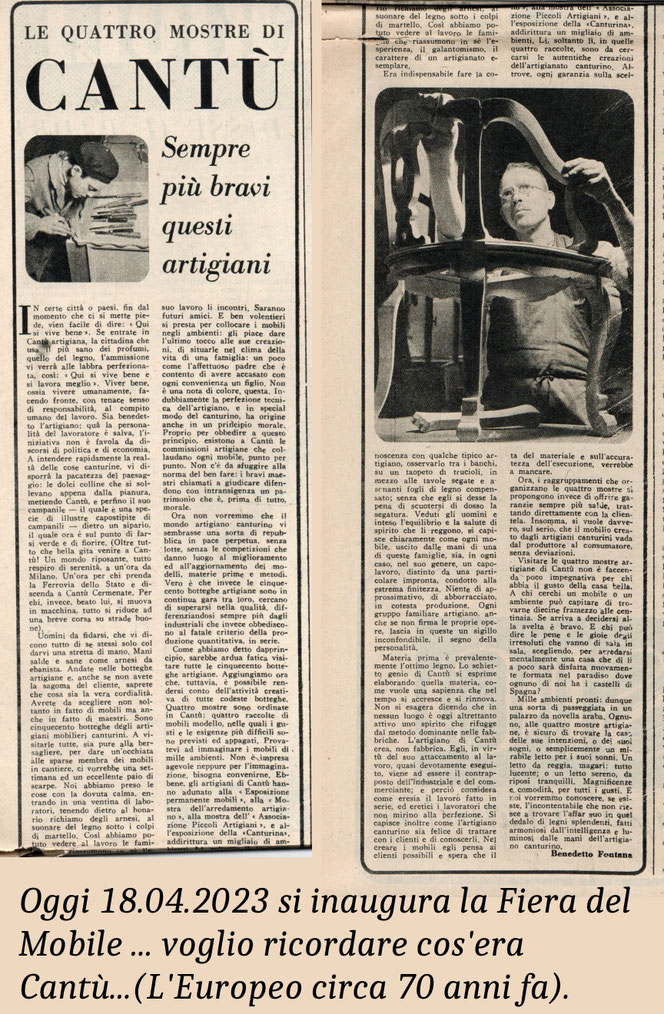
18.04.2023, Cantù, Como Italy : The furnishings also included bedspreads, tablecloths, sheets, curtains and doilies in Cantù lace.
The artisans offered complete interior decor solutions, combining high quality with fair prices.
The images and texts presented on this page are protected works.
Any form of reproduction or distribution without prior written authorization is prohibited.
High-resolution images and documentation are available upon request.
A confidential viewing of the original works is available upon request.
Serious inquiries only.