
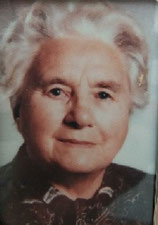
Maria “Persiglia” Marelli
a life at the bobbin lace pillow, between courage, work and dignity
Born in Montorfano (Como) around 1906, Maria Marelli – affectionately known by everyone as “Persiglia” – belonged to that generation of quiet yet decisive women who changed history without ever appearing in the books. Her personal story is intertwined with that of the Como area, with the work at the tombolo (bobbin lace pillow) and with the slow emancipation of women in an Italy that was still deeply patriarchal.
Widowed at around forty, with four children to raise and a future to reinvent from scratch, Maria could have withdrawn into the traditional role assigned to her by society: home, children, housework, and perhaps a few sewing jobs to make ends meet. She did not. Instead, she chose the harder path: turning women’s knowledge – often confined within the walls of the home – into work, income and dignity.
In this, her figure recalls women like Emmy Schoch or Countess de Brazza: personalities who, in different contexts, understood early on the value of women’s work, artisanal creativity and the possibility of transforming a “home craft” into a small enterprise rooted in the local area.
The birth of Manifattura Marelli
Out of her determination came Manifattura Marelli, a reality that was not just a production workshop, but a true informal school of independence for many women in the area.
With the help of some of the first bobbin lace designers, Maria began to develop collections of household linens: tablecloths, doilies, sheets with embroidered corners, table sets and trousseau ensembles – all inspired by the techniques that the Cantù lacemakers knew and had passed down for generations.
Her achievement was not only to “put the lacemakers to work”, but to give shape to coherent collections, designed for a wider market, with carefully studied patterns, precise measurements and clear quality standards. In other words, she transformed a diffuse know-how into an organized manufactory, giving professional dignity to women who, until then, had often worked in isolation and with little recognition.
The bobbin lace pillow as a path to redemption
In the Cantù community, work at the tombolo was already known and appreciated by “many gentlemen”: well-off families, professionals and holidaymakers who came to the lake and to Cantù in search of unique pieces for their homes.
Thanks to Maria, that appreciation found a new framework:
-
lace was no longer just a “little job” for housewives,
-
it became the product of a recognizable manufactory, with a style, a name and a story.
For many women in the area, working with Manifattura Marelli meant:
-
bringing income into the family,
-
being able to work while maintaining their role as mothers and wives,
-
and at the same time stepping beyond the purely domestic sphere, feeling part of a larger project.
A pioneer of quiet emancipation
At a time when no one was yet talking about “women’s empowerment”, Maria Marelli was practising it every day, using the tools she had: the bobbin lace pillow, the threads, the designs, the patience of handwork, and that specifically feminine ability to hold together home, children and enterprise.
Her courage had two dimensions:
-
Personal, because as a widow with four children she chose not to surrender to poverty, but to react by creating work.
-
Social, because she offered other women the chance to move beyond the domestic role alone and to recognise themselves as workers, artisans, professionals of lace.
Like other women of her time, she never sought the spotlight: her “stage” was the worktable, the loom, the tombolo, the room where patterns, measurements, deliveries and clients were discussed.
A recognition she deserves
Today, when speaking of Pizzo di Cantù and its history, a special recognition is certainly due to Mrs Maria “Persiglia” Marelli.
Her manufactory was not just a business: it was a threshold between two worlds – between a past in which women were confined to the hearth, and a future in which their artisanal talent could become work, income and professional identity.
To remember her means:
-
honouring a pioneer of women’s emancipation in the Como area,
-
recognising the value of the often “invisible work” of so many lacemakers,
-
and understanding that behind every doily, every border, every tablecloth from Cantù, there is a story made of courage, effort, choice and love for one’s craft.
In an age where everything seems fast and easily replaceable, her example continues to remind us that true modernity often begins with those who know how to preserve and renew a tradition, thread by thread, stitch by stitch.

Within the history of Manifattura Marelli, a key role was played by the designer Mrs Fiorella Marelli, daughter of Maria “Persiglia”.
Thanks to her refined taste and strong aesthetic sensibility, many of the patterns she created are still used today to produce authentic Pizzo di Cantù.
Over the years, her experience was further refined through collaboration with the Art School, which allowed her to improve her designs and make the patterns easier for lacemakers to execute, without sacrificing the richness and complexity of the motifs.

In the history of Manifattura Marelli, the role of the son Mr Paolo Marelli, a merchant, was also fundamental.
Thanks to his skills and commitment in the 1970s, numerous collaborations were established with lace and embroidery ateliers across Italy.
These boutiques, representing the finest Italian craftsmanship and located from Bolzano to Palermo, were proud to offer their customers the exclusive creations of Manifattura
Marelli.
The Cantù bobbin-lace artworks stood out clearly from imported products due to their refinement and impeccable execution.
Within the history of the Marelli Cantù bobbin-lace tapestries/rugs, a key figure has been Paolo Marelli, who played an important role in several
international cultural and commercial negotiations.
Highly regarded in diplomatic circles for his transparency and integrity, he held significant responsibilities in both civil and military-related contexts, facilitating dialogue and forms of
intermediation between States.
Thanks to his charisma and his deep understanding of Italian high craftsmanship, several exhibitions were made possible to highlight Cantù lace and Italian textile excellence.
His work led him to operate across Eastern European countries and Russia, where he represented prestigious Italian companies in the fashion and accessories sector, as well as in the Gulf region,
where he oversaw representation and commercial development projects.
Together, these experiences portray Paolo Marelli as a cultural mediator and a bridge between Italian craftsmanship, institutions, and international markets — the broader context in which the history of the Marelli tapestries is situated.
Note by Paolo Marelli, 1980
Even today, an increasing confusion can be observed in the use of terms related to lace-making. Words rooted in our tradition—pizzo, merletto, Cantù—are sometimes used to describe objects that have nothing to do with the origin, technique, and cultural heritage these names represent. In commercial language, designations originally meant to identify a precise school of craftsmanship risk becoming merely evocative labels.
Those who work in the field are able to recognize when an object is the result of a local tradition and when, instead, it comes from imported production. The general public, however, does not always have the tools to make this distinction. An Italian-sounding name alone is often interpreted as a sufficient guarantee, even when it is not.
This situation is not without consequences. If the value of artisanal work is gradually replaced by imitations, what is lost is not only the quality of the object, but the very continuity of the knowledge that generates it. Without a clear distinction between what is truly made here and what is merely called the same elsewhere, there is a real risk that, over time, the number of Italian artisans capable of passing on these techniques will continue to decline.

Mrs. Donatella runs the Marelli Pizzi store in Cantù, a true reference point for lace from the Brianza area.
“Italian excellence is served” through:
-
bobbin lace;
-
patterns and pricking designs for the lace pillow, suitable for different skill levels;
-
creative ideas for new projects;
-
refined household linens;
-
sacred and liturgical items.
The actual beauty of each piece and the unique style that Pizzo di Cantù brings to any setting truly leave visitors speechless.
The collection is wide and constantly updated, with proposals designed also for today’s younger generations.
Click on
the images
to explore our
collections.

